|
|
STEP #1: ADD HYDROGEN PEROXIDE TO YOUR WATER INSTEAD OF CHLORINE! CLICK HERE TO DOWNLOAD INFO ABOUT DRINKING WATER
Murray Bast, the president of Bio-Ag Consultants
& Distributors Inc., is devoted to understanding and working with nature by producing and supplying products and services
that support true sustainable agriculture (livestock and crop production). Hydrogen
peroxide is effective at reducing many of the problems associated with both residential and farm well water, including, dissolved
ferrous iron, iron slime, manganese, calcium and hydrogen sulfide. Click on the link below to listen to an audio recording by Murray Bast.
CLICK HERE - Water Treatment Audio For further information, contact: Murray Bast, President Bio-Ag
Consultants & Distributors Inc. 1400 Greenwood Hill Rd. P.O. Box 189, Wellesley, Ontario, Canada N0B 2T0 Toll Free 1-800-363-5278 Local:
(519) 656-2460 or (519) 656-2481 Fax: (519) 656-2534 Head Office Hours - Monday-Friday 8:30am-5:00pm info@bio-ag.com http://www.bio-ag.com or... Contact Randy Navratil at... Essential Water Solutions, Inc. 327 Hillcrest Drive Story City, Iowa 50248
USA Office: (515) 523-7011 Cell: (515) 290-9070 Fax: (515) 598-7294 E-mail: randy@essentialwater.net http://www.essentialwater.net Hydrogen Peroxide is Very Economical to Use: Available in 34% and 50% concentrations for just pennies a day. Peroxide application into the well water, or city water, can best be accomplished by a metering device, which keeps the application more constant and thorough (although manual application can be a second best). Automatic injection pumps can administer 10 PPM to over 1000 PPM with a digital control box that allows better accuracy and water metering capabilities. The rule of thumb is 8 to 10 oz. of 35% hydrogen peroxide to 1000 gallons water striving to attain a reading 30 ppm after application. This same ratio is used for all animals: cows, pigs, poultry, sheep, goats, rabbits, and birds. In
order to get a true reading of the amount of oxygen remaining in the water after the
application, use peroxide test strips, designed
especially for this very purpose. When peroxide is being applied throughout the entire watering system, with a reading of
30 ppm at the end of the line, all the water should stay clean of rust, bacteria, and
algae, plus some other foreign materials found in some water. Thus the waters stay
clean and help to stop the spread of diseases. Through this method of water purification,
there have been many reports of cows passing worms, hogs without even parasite eggs
in the fecal matter (with no previous worming medication for over an extended period of time). Some animals cut back on feed (depending on the nutrient level in their feed program). This process of water purification is especially
helpful in a confinement barn of any animal.
Simply by switching from chlorine to hydrogen peroxide... Hog farmers have reported that they have been able to market their hogs using less feed in a shorter growing time (as much as 30 days less). Turkeys and chicken growers reported increased weight per bird using less feed. A man in Wisconsin reported that he has had the best reproduction rate of his buffalo since using hydrogen peroxide in their drinking water. Livestock & Poultry Producers Have Reported: • Cleaner well pumps/water pipes/waterers • Increased water/feed consumption of animals • Reduced respiratory or gut problems • Improved daily gains • Increased feed conversion • Lowered medication costs and vet bills • A way to dechlorinate chlorinated water supplies • A natural deworming effect • Higher conception rates Swine Producers Have Reported Lower Incidences Of: • Ileitis • Hemorrhagic Bowel Syndrome • PRRS • Circo Virus • Strep Infections • E. Coli Dairy Producers Have Reported: • Increases milk yield (peaks are longer) • Lowers somatic cell counts • Increases butterfat levels with proper nutrition • Reduces retained placentas • Helps reduce scours in newborn calves • Increases levels of colostrum after calving • Reduces incidences of mastitis • Eliminates foot rot • Can be applied topically to hairy warts • Improves conception rates • Stronger heat cycles Feedlot Cattle Producers Have Reported: • Reduced shipping fever • Improved hoof condition • Cattle are more content • Fewer waterborne diseases Poultry Producers Have Reported: • Fewer incidences of disease • Fewer leg and tendon problems • Drier litter • Better egg quality for layers • Better feed efficiency Testimonials "Oxy Blast has virtually eliminated all strep infections in the knees and joints of my swine herd in the finishing barn. I also had almost no tail ender pigs last month for the first time." - K.K., Nebraska "With the use of Oxy Blast, we have seen more consistently high dairy milk yields. In fact, last month was our highest average yield ever. Rust is no longer a problem either." - E.L., Iowa "We used to go through pallets of respiratory drugs for our hogs, but now with the use of Oxy Blast in the water, we use almost no drugs." - M.B., Minnesota "We replaced chlorine with Oxy Blast in the water for our 1000 sow operation and saw our scour problems almost completely go away. The bacterial rust has also disappeared and the rust staining was reduced extensively." - E.P., Illinois "We've been able to replace the chlorine and the citric acid with Oxy Blast alone in the water of our layer flocks at a very economical price." - D.N., Iowa "After 22 years of using plain hydrogen peroxide, I tried Oxy Blast on my dairy cows. I noticed my somatic cell count was reduced substantially and the overall health of my herd has also improved." - R.E., Wisconsin "Oxy Blast has replaced almost all of my antibiotics in my swine finishers, reduced death loss, and helped my pigs gain almost 2 lbs. per head per day! Water consumption has increased dramatically and the pigs are more active. My site manager even said he would be willing to pay for the Oxy Blast before he would let me discontinue using the product." - T.T. Iowa What kind of benefits can you receive from simply adding hydrogen peroxide to your drinking water? Ask this cow... 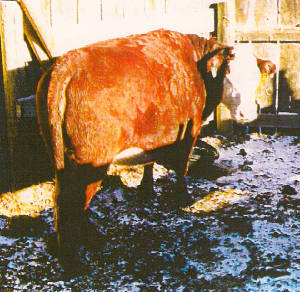 Okay, she doesn't say much, so you will have to download the following story
to learn how hydrogen peroxide in her drinking water cured her of a serious case of cancer of the eye! DOWNLOAD Details of How Joan Babe's Cow Was Cured of Eye Cancer! STEP #2: GET OXYGEN INTO COMPACTED
SOIL FOR HEALTHY ROOTS!
Alwyne Pilsworth, a British agronomist, has performed numerous farming
studies utilizing various forms of peroxide. His focus was mostly on potatoes, but the information he provides is applicable
to any plant. Click on the link below to
listen to an audio recording by Alwyne Pilsworth.
According to Alwyne Pilsworth... "We always use 35% Food Grade Hydrogen Peroxide. This product is widely used throughout the world for sterilizing soft drink and milk containers, and like peroxyacetic acid, it is totally environmentally friendly. We have found hydrogen peroxide to be an excellent growth promoter/sterilant treatment for any and all plants. It clearly promotes protein growth and stimulates carbon dioxide fixation. We use one pint per 20 gallons of water sprayed broadcast per acre. For frost prevention we spray it on the day before frost is expected. We found that spraying it on crops which are white with hoar frost will markedly reduce frost damage. Hydrogen Peroxide is a tremendous drought resistance factor, probably due to a stronger deeper growing root system. With fruit trees sprayed at petal fall, fruit seed is greatly enhanced. The fruit is larger at harvest and the improvement of flavour and sweetness is unbelievable. All spray treatments are best applied in the early mornings or late evenings when dew is present and relative humidity is higher that 70% (80% plus is best)."
STEP #3: FOLIAR SPRAYING Listen to the following audio clips from Murray Bast - Very informative and entertaining!
Mixing Peroxide With Other Material
STEP #4: MAKE A COMPOST TEA
STEP #5: INTRAVENOUS USE IN FARM ANIMALS DO NOT DO THIS WITH DOGS!! Canine systems are different and they should NOT receive hydrogen peroxide intravenously! FURTHER DETAILS ON THE FARM USE OF HYDROGEN PEROXIDE: CROP SPRAY / FOLIAGE FEEDING Put 5 to 16 oz. of 35% food grade hydrogen peroxide into 20 gallons of water. Spray on plants early in the morning when the dew is still on them with a humidity of 70%+) HYDROGEN PEROXIDE AND COWS It was in 1985 that the first dairy farmer began injecting hydrogen peroxide in the water system of his whole farm. The water on his farm was polluted and mastitis was a problem with his herd. After continual use since that time, this same farmer noticed with satisfaction the healthy state of his cows. In April, 1988, the butterfat content of his Holstein cows was up to 5.3%. Another farmer who weighs the milk from every cow at every milking, reported that his milk production increased from 6 to 8 pounds per cow per milking. Others have reported their bacteria count has gone down to less than 2,000 per cubic centimeter. Many other farmers are continuing this process. DAIRY Use as a pipeline rinse for milk stone, depending on the length of the pipeline. As a rule, 2 to 4 ounces of 35% hydrogen peroxide to 15 gallons of water will work with good results. This amount also works for rinsing milk cans and the bulk tank, to keep down bacteria as well as milk stone. (Note: If hydrogen peroxide is being injected into the water system at 30 ppm, the above ratio may need to be cut in half.) POWER WASH In the dairy barn as well as the hog house (in the sanitation process), mix enough peroxide into the water so that a light foaming action comes when spraying the floors and walls. Leave this until the foaming subsides, and rinse again. If the foaming action recurs, then the areas which still foam are not clean. Either raise the peroxide level of the original rinse water, or merely re-spray the areas still contaminated with the present amount. UDDER WASH Use 1 oz of 35% hydrogen peroxide to a gallon of warm water. The cows tend to have softer teats and are freer of bacteria on the teat ends, which helps to keep down bacteria in the bulk tank. TO PREVENT SPOILAGE Depending on the time of year, pH of the milk, temperature, etc., you can use from 1/4 oz 35% hydrogen peroxide (up to 1 oz. 35%) hydrogen peroxide per gallon of colostrum/milk. NEWBORN CALVES Add 10 to 15 drops 35% hydrogen peroxide to a bottle milk, morning and evening, per calf. This has helped to brighten up calves, and in some cases of scours, depending on the pH of the milk being fed. DRENCH
This can be given for high fever and off feed cows with mastitis(depending on the situation and case). Mix 1 to 2 ounces 35% hydrogen peroxide to 1 quart of water, drenching the animal morning and evening for as long as needed (2-3 days). AILING
ANIMALS Use 1 pint of 3% hydrogen peroxide to 5 gallons of water. WOUNDS Clean the wound of animals with 3% hydrogen peroxide. INDUCE VOMITING In animals with 3% hydrogen peroxide. AFTER THE BIRTH OF CALVES Farmers have reported that their cows settle and clean out faster after giving birth to a calf with hydrogen peroxide is added to their drinking water. CONVERTING CROP RESIDUE INTO CATTLE FEED Hydrogen peroxide has also been used inconverting crop residue into cattle feed. It is possible to treat straw, cornstalks, corn cobs, soy bean residue, sawdust or even ground up brush with a weak solution of hydrogen peroxide in order to convert them into animal feed. THE BIRTHING OF PIGLETS Details coming soon CONTROLLING MANURE ODORS Livestock farmers know that manure and odor are a part of everyday life on the farm, but there are risks to farm workers associated with emptying manure pits and spreading it on land. Their nonfarming neighbors, however, are much less accepting of manure. To them, it causes air pollution and they worry about its potential to seep out of its storage pits and contaminate their ground water. The odor from manure pits is primarily hydrogen
sulfide that is produced by anaerobic bacteria. It takes a healthy population of microorganisms, both anaerobic and
aerobic, to do an efficient job of digesting manure. Unfortunately, many manure pits end up with a thick crust that excludes
oxygen from the manure, excluding aerobic bacteria and leaving only anaerobic bacteria.
|
||||||||||||||||||




Consider this other fine book
Click on the book for further information...

CLICK HERE to order Becky Mundt's 101 Uses For Hydrogen Peroxide!